Start or
Stop Service
Check Out
Bids and Contracts
Report a Problem
or Emergency
Rates and Fees
New Customers
Click Here!
Reducing Water Loss with Continuous Monitoring Sensors
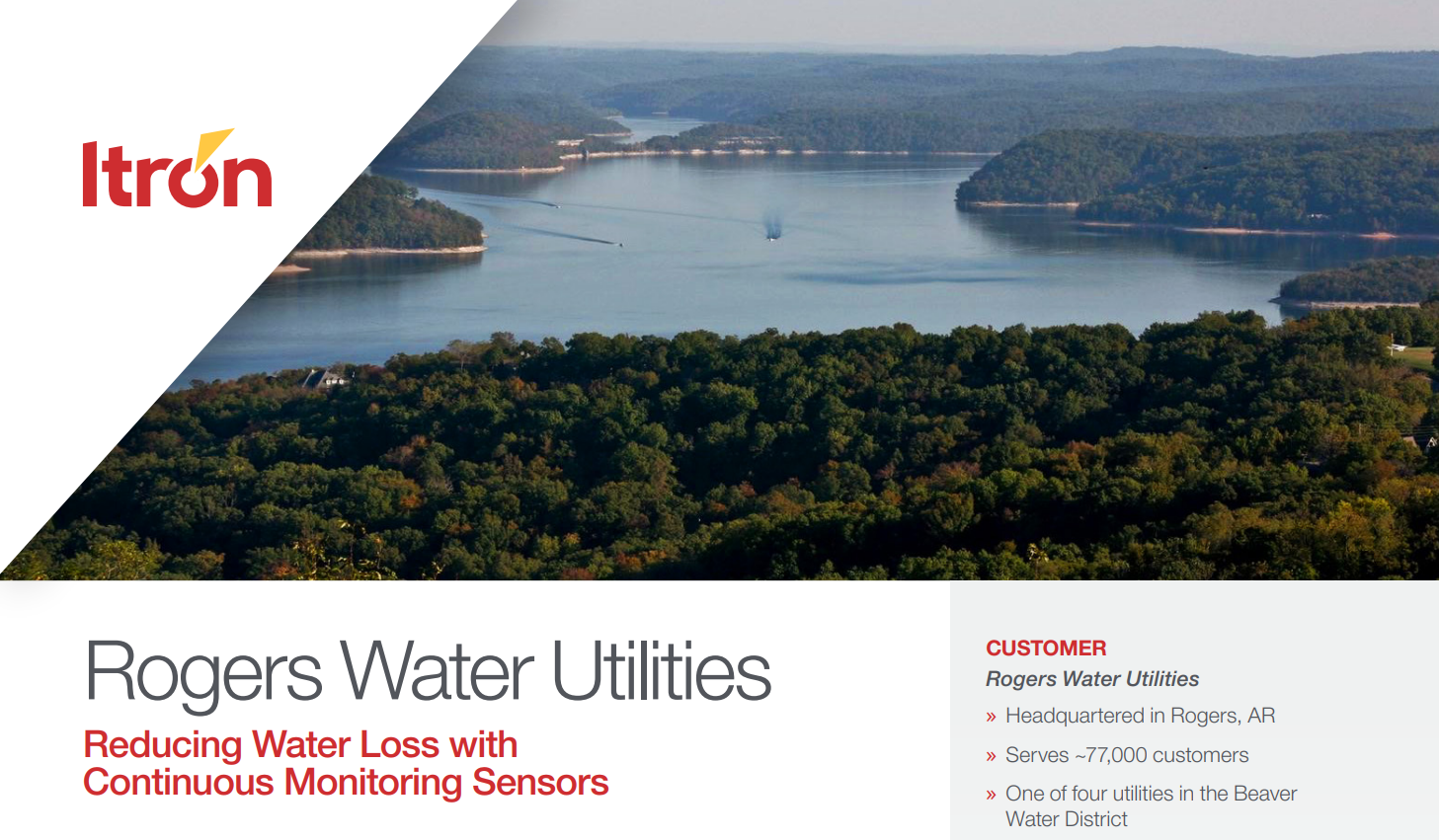
Rogers Water Utility (RWU) in Rogers, AR, took action to mitigate constant leaks in its distribution system, which made it challenging to maintain volume in the eastern district’s water tower. By adding tools to locate and mitigate leaks, RWU was able to reduce non-revenue water, increase water pressure for residents, and create a more sustainable water system in neighboring cities.
Rogers, AR, is a vibrant and rapidly growing city of 77,000 people located in the northwest part of the state. The community is served by RWU, one of four distribution utilities in the Beaver Water District, which provides drinking water and wastewater services. RWU leveraged Itron’s acoustic leak detection, a simple but powerful technology that helped the utility identify the location of leaks throughout its eastern district and beyond. The result was more than just a rapid return on investment (ROI), including water security for their community and even neighboring cities.
A Matter Of Pressure
The area features soft, rolling hills, as well as a number of natural springs and proximity to lakes. While beautiful, the topography and geology are a challenge for RWU, as rapid changes in pressure and other factors can cause frequent leaks in the distribution system.
The struggle to maintain water levels in the tower was a big challenge for RWU. Local regulations require utilities to issue boil water notices whenever a water tower falls under 20 psi. During peak usage, the tower would hover dangerously close to that line.
“In the summers, especially, first thing in the morning, people will turn on their irrigation systems,” said Johnny Lunsford, operations manager at RWU. “That is also the time of day that they get up, take showers, and get ready for work. And that’s when our levels in the water tower would bottom out. We’d see a slight recovery during the day, but when everyone got home, the levels would drop again. They’d rise a bit at night, only for the same thing to happen the next morning.”
The fact that it could maintain water levels during off-peak hours, Lunsford said, indicated that the problem was leaks in the distribution system. But finding leaks in more than 83 miles of underground pipes was a daunting task.
RWU hired an engineering firm to create a water master plan. The plan showed the need to increase ground storage, add a water tower, and install a parallel 24” water line –– a multi-million-dollar proposal that was just too far out of reach.
Acoustic Sensing
“We then realized that Itron had already supplied all of our water modules for mobile meter reading and that it has an acoustic leak sensor that can be added on,” said Lunsford.
Operators installed 650 acoustic leak sensors on the required meter distance for the type of pipe in the eastern territory. The sensors listen at night when background noise is the lowest. Leveraging existing automatic meter reading (AMR) technology, operators pick up the leak data during routine truck rolls.
The effectiveness of the solution was immediately apparent. With the data collected and analyzed, RWU was able to prioritize leak repairs according to severity. The eastern territory went from 18% non-revenue water (NRW) to less than 5%, saving more than $200,000 and 150 million gallons annually. Even better, the water tower hasn’t come close to the 20-psi regulatory line since, rarely dropping below 42 psi, according to Lunsford.
The success in the eastern territory helped Lunsford convince management to accelerate the installation of the acoustic leak sensors throughout the entire RWU drinking water distribution network, including in town where they felt things were much more controlled. Six weeks later, the managers got a big surprise. “We found leaks running down storm drains and underneath the streets,” said Lunsford. “Some of those had been leaking for who knows how long and they never surfaced until now.”
Crisis Recovery
Adding acoustic leak detection has also made the city more resilient. In May 2024, a tornado hit Rogers. The damage caused leaks so severe that they were quickly draining the water tower. However, thanks to acoustic leak detection, operators were able to track them all down within four to five hours. The damaged lines were isolated and normal water service was restored the next day.
That resiliency extends to neighboring cities as well. In 2021and 2024, nearby Bentonville, home to a retail giant’s corporate headquarters, had to replace a broken section of 48” main that would cut off most of the city from clean water for more than two weeks. RWU was able to step in and supply Bentonville’s 55,000 residents and businesses with water while also maintaining water levels at home. “If we hadn’t been doing all the work to keep our lines as tight as they were, we wouldn’t have been able to provide the amount of water that they needed,” said Lunsford.
By adding Itron’s acoustic leak detection solution, RWU was able to completely transform its water management while also bolstering its resilience. The affordability and ease of integration into its existing AMR system ensured a rapid and significant ROI. It now has 1,800 acoustic leak sensors proactively listening daily for leaks.
Rogers Pollution Control Facility Improvements
Rogers Water Utilities is pleased to announce the construction of Phase II of the Solids Handling Facility at the Rogers Pollution Control Facility.
This project will benefit the community by greatly improving the ability to process materials removed from the wastewater (i.e. “biosolids”) by thermally drying the materials to form a marketable, nutrient-rich fertilizer product. Drying the biosolids product also facilitates economical hauling of material outside of the Osage Creek / Illinois River Watershed, which ultimately improves water quality in the receiving streams. This process complies with the accepted Watershed Management Plan developed in accordance with the Clean Water Act. Construction of upgrades and improvements to the Rogers Pollution Control Facility are financed by the Clean Water State Revolving Fund. The CWSRF program is administered by the Arkansas Department of Agriculture, Natural Resources Division with joint funding from the U.S. Environmental Protection Agency and State of Arkansas.
Our Mission is to enhance the quality of life for Rogers Water Utilities customers by delivering high-quality water and dependable service that exceed customer expectations; protecting and ensuring a long-term water supply for future generations; and serving as responsible stewards of public health, utility resources, and the environment.
When is my bill due, and how can I pay it?
Choose the best payment method for you
- In the office 8:00am – 4:30pm, Monday through Friday
- Drive-Thru 8:00am – 4:30pm, Monday through Friday
- By mail*:
P.O. Box 338
Rogers, AR 72757
* Make checks payable to Rogers Water Utilities. Please include account number - Drop box at the Drive-Thru
- Pay by phone – (877) 469-2524 * No Convenience Fees *
- Online via the Account Management Portal – Including autopay and one-time payment options * No Convenience Fees *
Bills are due upon receipt and are considered past due after the due date listed on the bill. A 10% penalty for late payment is assessed after the due date and service is subject to disconnection 30 days after the bills are mailed. It may take up to 48 hours to reconnect service that has been shutoff due to non-payment.
If I have a sewer stoppage what should I do?
Call the sewer department immediately at (479) 621-1142 before you call another service professional. RWU will determine if the cause of the stoppage is on the private system or the sewer main.
What do I do if I have a question regarding my trash bill?
Call Lakeshore Recycling Systems (LRS) at (479) 878-1384. Their office hours are Tuesday-Saturday 8am – 5pm